A Smarter Way to Learn HTML & CSS: Learn it faster. Remember it longer.
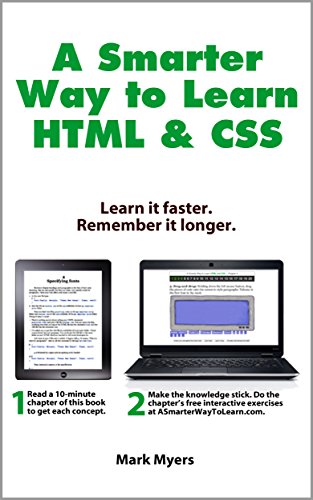
Using the Smarter Way to Learn method, you actually learn HTML/CSS, you don’t just read about it.
Research shows that you learn four times as effectively when you practice after you read. So each chapter is paired with free, interactive exercises--more than 1,000 of them in all. You know you're learning because you can prove it to yourself.
- Testing shows that books and courses load up the learner with too much information at once. Smarter Way chapters are divided into bite-size chunks so you're not overwhelmed.
- Reader friendly. No jargon. Everything is explained in plain, non-technical English.
- Written for beginners, but experienced developers will find it valuable for brushing up their skills.
- Exercises are free and interactive, online.
- Lots of coding examples and illustrations.
- Re-do an exercise as many times as you need to until you get it right and know you got it right.
- Each group of exercises builds on previous chapters so learning is reinforced all along the way.
- Automated Exercise Manager corrects your mistakes and points you in the right direction when you stumble.
- The Smarter Way to Learn series is the most-praised collection of programming books on Amazon. These books have earned more than a thousand 5-star reviews from Amazon readers.
Read the reviews that call The Smarter Way of learning fun, involving, frustration-free, and confidence-building. Then, if you want to go beyond reading about HTML & CSS and actually learn the skills, do it the smarter way.
Reviews (182)

Outdated technology
This is a great tutorial as far as layout and hands on learning, but... and this is a BIG one... it's old technology. Websites use flexboxes now, not table as an example. If this was updated I'd definitely be first in line to purchase it, but as it is, I wish I had passed.

Learn to retrain and reinvent ourselves to adapt to new technologies... -- from Mindshift "Barbara Oakley, PHD"
I am 64 years old, I took a HTML & CSS test recently and scored a 35, I had taken some on-line training and had been frustrated by not being able to remember effectively when it came to test time. 1) The cognitive approach that Mark Myers uses is for the reader to spend 5 - 10 minutes covering the key elements. 2) Then the reader practice's by answering 20 questions that cover the key elements. 3) The questions are styled in away that causes the student to retrieve the "key elements" using five different ways of typing their answers: --non-timed big box entry --puzzle assembly --small box: single key stroke entry --timed big box entry --lab style questions The student is forced to use multiple visual learning modalities. This approach causes the user to start creating NEW neural pathways in their brain which is "A smarter Way to Learn" I just finished the 10th chapter and I am noticing that I am remembering more!!!

Read, Practice, Walk Away...🤓
This is a great way to learn code! I am a hands on learner and sometimes, it's hard for me to stay focused. I can easily get 3 chapters done a day, and retain the information. I tested this yesterday...after I got home from a long, grueling day of work😣...i sat down and started reading. The chapters took 5-10 minutes at most to read, then, at the end of the chapter, you are directed to go to the practice site. Each chapter has its own practice link. You type in the answers and if you get an incorrect answer, it will go back to it once you have completed the other questions. It will do this until you get it right..I was able to complete 3 chapters and practices last nite and then I walked away..which the author recommends. Today, I started again and I was able to complete three more..having the ability to actually do the steps myself made me realize that it doesn't have to be complicated and there isn't just one way to learn coding, but I found the best way for me. There are programs and books out there that just throw you into coding without showing you the basics first and it can make it more difficult than it has to be. If you are a newbie and you are ready to do what it takes to learn coding (it takes a serious commitment), I would recommend this series to help get you off to a great start! To your success!

Excellent way to teach yourself coding
I have always had an affinity/natural ability for computer programming, but was unable to take that as my major course of study at the campus I attended when I went to technical school a little 'later' in life. I was able to take a couple of classes in a couple of languages back then, and although I loved it and was good at it, it is still challenging to learn even when you have instructor and tutors to learn it from right in front of you, so now, even more 'later' in life when my ability to learn isn't nearly as quick as when I was younger and my memory is worse, when I wanted to teach myself so I could finally do what I really loved, I knew I was getting into a big challenge for myself. While searching for books here on Amazon, I stumbled across Mark's books while looking up JavaScript texts. His books were highly reviewed and I knew from my previous experiences that the best way to learn coding is to practice it yourself (because in a way you're learning a whole new language; a certain, precise way of thinking). I was very excited that the chapters were short and you practiced every chapter to really get this into your memory (old as I am now, this is a very important aspect). I got the JavaScript book first (which I haven't reviewed yet as I haven't finished it yet), and then found that I really should know HTML/CSS in order to plug in my JavaScript code into the webpages that would be using it, so about halfway through that book I purchased this one and started it. I have really enjoyed this way of learning. I've finished the book before reviewing, the only thing I haven't done is the last "exercise" which is to build my own 3-page webpage. I wanted to wait to review til I truly had gone through the whole book so I would be giving an honest review that is truly from my own experience of the learning process in the book. Just a note, although I firmly give this a very enthusiastic 5 stars, there are a few typos here and there in the book. I have read other self-published books, so that doesn't phase me, I knew what was being communicated or if there was some punctuation or the like left out of a coding example in the book, it was already so impressed on my brain the correct way to do it, sometimes I didn't even notice those tiny errors myself until I was copying the examples into my notes! (which really helps my memory) Final note, all Mark's books in particular are so incredibly inexpensive for the Kindle e-reader version that's why it was so easy to make the first purchase that I did. I downloaded the Kindle for PC app and then could work on either my desktop at home or laptop when traveling, so made it quite easy to continue studying even when I'm here, there and everywhere during my week. Another note: Mark has made it so you can only go to online exercises link from the e-book from PC, not Kindle Fires, phones or tablets, which makes sense because it would be incredibly difficult to code from any of those devices, in my opinion. Main point: if you want a way to teach yourself coding, I think this just might be the best way to do it, most bang for your buck! Final point: please Mark come out with a PHP book soon! That is what I want to learn next after finishing your JavaScript book!

If I can do it, so can you!
I wanted to learn to code, but the hardest part was just learning HOW to study. I'm a reader, but most learn-to-code websites have you work directly in a text editor and you go from one lesson directly into the other. When it came time to do exercises, I had no references to work from. I decided to go back to basics and learn HTML & CSS first, but came across the same issue. Downloading cheat-sheets were useless without context. Then - I found this. THANK YOU GOD for this book. Each lesson is in the book is short and simple (but not dumbed down). After reading the lesson, you follow up with the online exercises, which are fun and gratifying because you realized how much you just learned. There are a number of exercises for each chapter, and they repeat in different variations - the repetition helps immensely. During the exercises you are also prompted to work in an online editor to put what you just learned into practice, and you get to see your coding in action. After going several weeks without working on it, I was mad at myself thinking I'd probably have to start all over again. I went to the online quizzes first to see if I'd retained any of it - and breezed through every single one of them. Every single one. I was able to pick up right where I left off with no review whatsoever. I DID learn it! I DID retain it! I GOT IT!! Can't wait to finish this book and then on to Java! I finally think I can do this!

Took a Class, This book is much better...
Last fall (fall of 2019) I took an introductory level class to web development. I honestly wish that I would have had more time with it because it was way more involved, even for an introductory level, where it seemed like the class was all learning at different levels, and the instruction was so-so. Some classmates knew what they were doing. I was one of the complete novices, and required additional help from my professor to figure out some of the nuances. I ended my semester not completing 3 of the assignments (in JavaScript) simply because I didn't have enough time to master the HTML and CSS with the minimal training. I really needed more activities to master this coding language. I want to note that I have a basic conceptual understanding of coding. I am a Special Education Teacher in Math and Sciences (teaching in subject content of Algebra). Pros: This book is well sequenced. It offers practical and SHORT activities for learners to apply their knowledge immediately and to test themselves on their knowledge as they go along. There are several activities that you can do at the end of each (2-pages at most) chapter to see if you understand the concept being taught. I appreciate how the author attempts to simplify the main concepts into short chapters so you can attempt to learn code quickly. He tries his best to also cover all basis, so if you had any questions that they might be answered by his explanation. Cons: Some of the examples are over simplified. There are some areas where it would be best taught if the reader had a solid example to copy exactly as is, only because there are some topics he did not cover enough of. I've noticed some really simple spelling and syntax errors in his examples that would cause the code to NOT WORK. I was fortunate to see them myself, but for other novices this can create hours of frustration. I still think that his intentions were good and this is one of the better books out there, but it could have used some more editing. This book also doesn't have enough visual examples for the user to learn independently. I think it's hard to have a happy medium of examples, but this book doesn't seem to have enough. A MAJOR ISSUE/FLAW with this text, is that the chapters should be treated as individual activities (in other words you cannot just use the same file because he recycles the same examples, so coding that was specified in a previous chapter might be different, but the new example will have the same name as the old one. This has caused me to create several instances of conflicting code because I was doing all the activities in the same file, never realizing that these things were going to interfere. It's basically poor style of writing on the author's part.) My textbook for my online class was extremely colorful and had tons of visuals, but it was honestly difficult to read because the numerous amounts of visuals had a lot of inconsistencies as to what was an example, and what was important information.

A great start to learning
I have been using this book, the "A smarter way to learn Javascript", codeschool, and am trying to get bitsbox to work. This book seems to be excellent for learning the nuts and bolts in bite sized chunks while applying the concepts in a way that forces you to absorb the material in a way that makes students repeat (great for memory) and think about how the code/syntax is actually working. A suggestion to the author and other learners: I think once these nuts and bolts are absorbed well and you feel like you're thinking "like a coder", there will need to be more exercises that cover two areas. 1st: Additive exercises within each book and related books. Meaning, maybe every three lessons, there are a new set of exercises that apply all the concepts of the preceding lessons. This would help ensure reviewing would take place and that using all skills would come together. If my understanding is correct, then adding exercises from related books (applying lessons from the Javascript book to this book) would also make sense. The second area would be to make more plain language, real world exercises/projects. For example, instead of making an exercise where the instructions are clearly written as "Write a paragraph with opening and closing tags where the 4th word is in bold using the alternative bold method.", perhaps something more like "You are teaching a class of 5 students how to code. You graded their tests and you need to post it on a web page. List the students results and make sure the students with high marks clearly see you congratulating them. Make sure the failing students clearly see they need to study more. Use stylized text to help make your messages noticeable." This would be more free form than training nuts and bolts and could be self checked in JSFiddle.

Simple book that is structured around a website where you have access to drills for basic HTML.
Don't fool yourself about that word "basic" in my title. HTML is deceptively easy to understand, but is difficult to recall without having experience. Pros: The intro of this book is what really sells why you should get this book. If you can relate to the intro, then this book is probably one you should get. The author does a good job teaching by keeping things simple. The drills are what give you experience, and that gives you the ability to recall the elements, attributes, and values. Even without the website, this book is more easy to digest than most websites out there, and is probably worth the purchase without the website, but just barely. The book truly is very simple. The author's website is for drilling what you read. The drills are very simple, and do seem lazily put together (they consist of 20 questions, the first 9 get repeated again in a timed drill -- last 2 are live coding drills via a third-party editor on a website). But this doesn't really matter. The point is you have access to drills that you didn't to take the time to create yourself. Cons: This book does not cover HTML5 elements. So you'll need to pick up another book with this one if you are striving to become a professional. The author's practice drills seem to have gotten too lazy about 2/3 through the book, so I stopped doing them -- admittedly, it is also difficult to create a practice drill when the course grows in complexity. So I sympathize with that. It wasn't an issue because the content becomes more conceptual than practice. Conclusion: I'm grateful for this book because the drills have built a good foundation in me. And from here, I feel much more prepared than I would have been without the drills, to go onto more sophisticated HTML books.

An Old Guy learning Code
I am an older guy that decided that I wanted to learn coding and get a basic understanding of Web Development. I use a computer but I am not a real "computer guy". I bought a couple of books to help get me started. I struggled at the beginning. I then came across this book (A Smarter Way to Learn HTML & CSS). I bought the kindle version. I love this book. The other books I bought have been set aside. I may come back to them at some point but this one is getting my full attention right now. The chapters are very short. Usually no more that 3 pages or so. Each chapter builds on the one before it. What makes the book for me is the interactive online tests that come with each chapter. They give you a real opportunity to see what you know. They also help to solidify that knowledge. Many times when I began a test for a particular chapter I wasn't sure if I had the concept down but by the time the test was completed I had it down. You can always go back to previous tests to make sure that you hold onto that information. Now understand that the tests can be a challenge and can be a little frustrating. You have to code the way the author does on the test and sometimes you have to do it just right. But that is alright by me. I'm learning and it is fun. I am grateful for the time and effort that Mr. Myers put in to making the online tests. I am planning on buying the books for Javascript and JQuery. I hope there will be more books like this to follow. Thank you Mr. Myers.

Wish more programming books were written in this style!
Mr. Meyer has produced a very good book and learning experience. It is divided into 90 short--often only one or two page--lessons covering the basics of creating a webpage. After reading the lesson, you code your own local text files, and then display your practice webpage in your browser. But the most unusual thing about the book is that each lesson has an online test you take to help you nail down the topic. The tests aren't hard, but Mr. Meyer is very picky with how your answers are entered, stressing the importance of strict syntax and good coding practices, and I found myself frequently frustrated when I made a typo or misunderstood a question and failed it. However, no harm no foul, you are given as many repeat tries as you need until you finally get it right. In that respect, working through the exams is very much like coding. Most coding errors in my experience are typos. I can't tell you how often I've written "left-margin:" instead of "margin-left:", and then pulled my hair out trying to figure out why my margins weren't changed. It's not a large book, but it took me nearly two months to work through it, because of the frustration I experienced doing the exams. I don't mean that as a criticism of the book, it says more about me than the book, I'm sure. At 90 lessons, if you do two a day (which was my norm), it will take you at least a month and a half to finish. At the end of every test, you have the opportunity to submit a form to Mr. Meyer if you've found any mistakes or misprints, etc., in the book or the online exam, and you can make suggestions to him there as well. To his credit, he responded to every post I sent him. I wish that feature were incorporated in other programming books. I have also purchased his two other works: one on Javascript and the other on jQuery. They're next to do on my calendar. If there is one thing I found super annoying about this book, it is the binding which absolutely refused to lie flat on the desktop as I was entering code into my practice files. I think a spiral binding would be a godsend, but that's a small quibble really, and for all I know too expensive to be practical. One last note: I'm not a newbie, I've created a dozen or so websites for myself and for non-profit organizations I've been active in, but I still learned many things in this book. I wouldn't consider for beginners only. Woops! One more thing. I usually buy cheat sheets for languages to keep on my desktop and look up tags and commands I will otherwise mix up. I think this book is small enough, and the table of contents will take you quickly to a given task and provide sample code for you along with an explanation. I doubt anyone will need a cheat sheet for the basics if they purchase this book.


Comments
Post a Comment